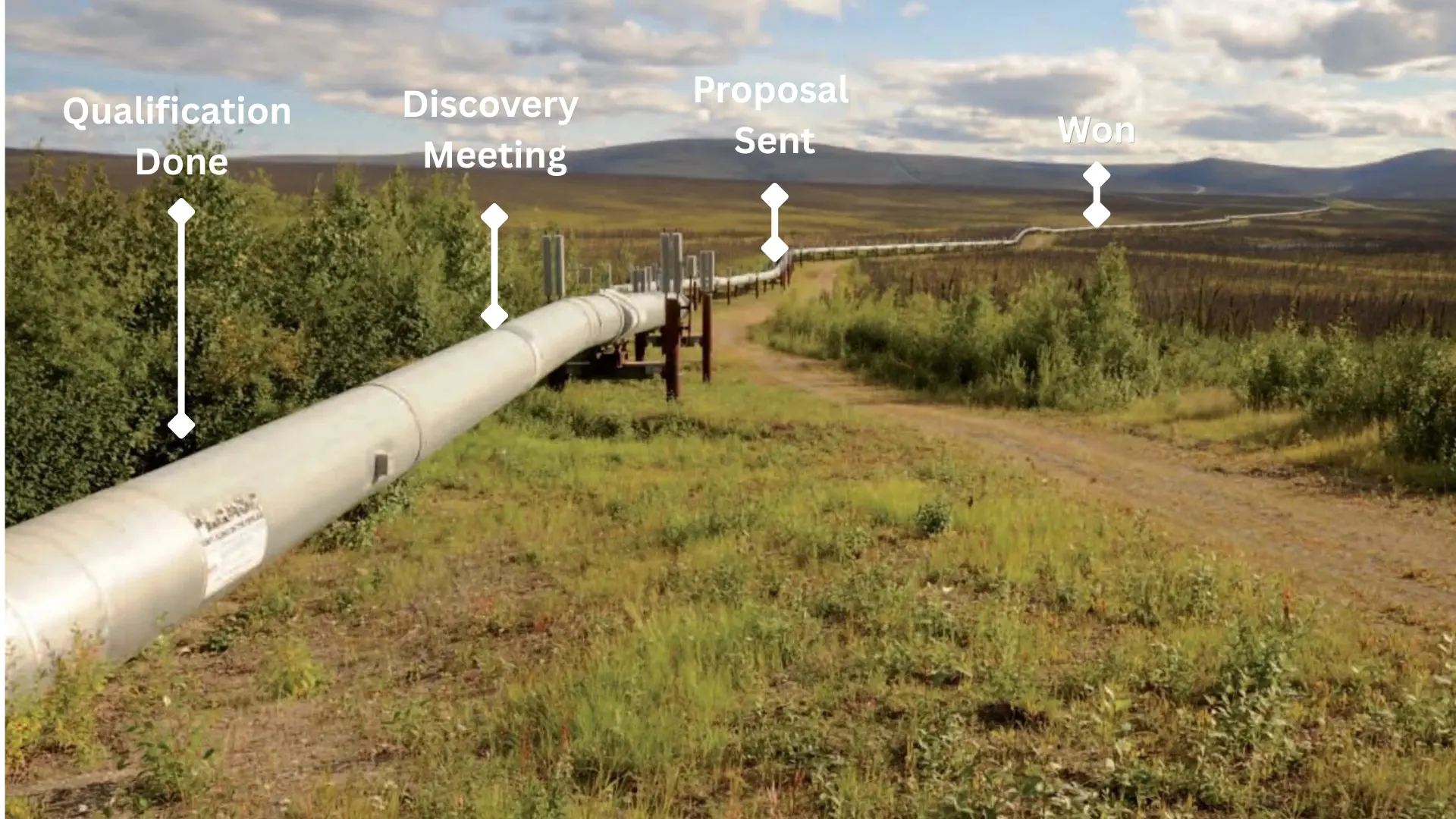
- Default pipeline stages describe what the seller did, not what the buyer decided. That is why they slowly stop meaning anything.
- One pipeline does not fit every industry. A construction tender and a SaaS trial do not go through the same steps, so they should not share the same stages.
- A stage is a checkpoint, not a label. If a deal can sit in a stage forever without proving anything, that stage is decoration.
- We cover five industries here: ICT and technology, real estate, SaaS, service agencies, and construction and contracting.
- Design your stages around how your market actually buys. The CRM only enforces the process you already decided on.
Open your CRM right now and look at the pipeline. Chances are half your open deals are stuck in one or two stages. "Proposal Sent." "Negotiation." "Follow Up." And the forecast at the bottom says this is a strong quarter.
You know it is not. Some of those deals died weeks ago. The rep never moved the card, because dragging it to "Lost" feels like admitting defeat, and leaving it in "Proposal Sent" feels like hope. So the stage fills up with dead deals, and the forecast quietly lies to you.
Here is what most sales managers miss: the problem is not the rep, it is the pipeline. It was copied from a ready-made template that came with the CRM. Lead, Contacted, Demo, Quote, Negotiation, Won. That sequence was not built for any real business, so every real business either bends its process to fit it, or ignores it completely.
A pipeline that does not match how you actually sell is worse than no pipeline. It gives you numbers you cannot trust, and a team that treats stage names as suggestions.
A Stage Is a Checkpoint, Not a Label
Before we get to the industries, one principle fixes most broken pipelines on its own. Every stage needs an entry criterion and an exit criterion. A deal earns its way into a stage by proving something, and it does not leave until it proves the next thing.
The test is simple. For any stage in your pipeline, ask: what must be true for the deal to sit here, and what must happen for it to move? If you cannot answer both in one sentence, that stage is a label, not a checkpoint. It is a place where cards go to wait.
The second principle: name stages after the buyer's commitment, not your own activity. "Proposal Sent" describes what your rep did. "Proposal Under Review" describes where the buyer is. The first is a filing status. The second tells you whether the deal is still alive.
A stage your deals never leave is not a stage. It is a waiting room with a nicer name.
Why One Pipeline Does Not Fit Every Industry
Five things change from one industry to the next, and each one reshapes what your stages should be:
Cycle length. A real estate client can close in a week. A construction tender can take nine months. A pipeline built for one will choke the other.
Who the buyer is. A single owner, a procurement committee, a technical evaluator, a government tender board. Every buyer adds or removes stages.
What "qualified" means. For an agency, it is a clear brief and a real budget. For SaaS, it is a confirmed use case and a decision date. Same word, different standard.
How the money moves. Upfront payment, milestone payments, monthly subscription, a year of retention. The cash structure changes where the real commitment happens.
What "won" actually is. A signed contract, a PO, a deposit, a Letter of Award (LOA), an active subscription. If your team disagrees on what "won" means, your pipeline is already broken.
You do not sell the way a contractor bids on a tender and a SaaS rep runs a trial. Your pipeline should not pretend you do.
Below are five starter pipelines, one per industry. Treat them as a foundation, not scripture. The stage names matter less than the discipline behind them: a clear entry, a clear exit, and a name from the buyer's side.
1. ICT and Technology
Long cycles, technical scoping, tenders, and procurement. The classic failure here is jumping from an exciting demo straight to a quote, before anyone confirms the solution is actually feasible and can integrate. Then the deal dies in a silent "Evaluation" with a tech team you never spoke to.
- New Inquiry. A real contact with a stated problem. Exit when the need and a rough budget are confirmed.
- Discovery and Scoping. You understand the environment, requirements, and constraints. Exit when you can describe the solution and name who approves it.
- Technical Qualification. Feasibility confirmed, integrations checked, and the technical evaluator involved. Exit when the solution is verified as deliverable.
- Proposal or Tender Submitted. A formal quote or tender response is submitted. Exit when the buyer confirms receipt and a review timeline.
- Procurement and Negotiation. Pricing, terms, and vendor onboarding in progress. Exit when terms are agreed and the PO is close.
- Won (PO Received). A purchase order or signed contract in hand.
Technical Qualification
Reps run a demo, build excitement, then send a quote before anyone confirms the solution can be built and integrated with existing systems. Put a feasibility gate between discovery and the proposal, and stalled "evaluations" stop ambushing your forecast.
2. Real Estate
High lead volume, and most of it noise. Agents chase everyone, take tire-kickers to viewings, and burn the week. "Reserved" also quietly blends into "Sold", so the forecast inflates with deals that never actually closed.
- New Lead. Inquiry logged. Exit when you reach the person and confirm real intent.
- Qualified. Budget, timeline, and purchase intent confirmed. Exit when the client is genuinely in the market and can afford the price range.
- Viewing. The unit is viewed in person or virtually. Exit when the client shows concrete interest in a specific property.
- Offer or Reservation. Reservation deposit paid or a formal offer made. Exit when reservation terms are accepted.
- Contract and Payment. Sale agreement and payment plan in progress. Exit when the contract is signed and the first payment is collected.
- Closed Won. Contract signed and payment secured.
Qualified, With Budget and Timeline
Agents take everyone straight to a viewing, spending real hours on people who were never going to buy. Confirm the money and the readiness before you book the car. A cheap disqualification early beats a wasted Saturday later.
3. SaaS
Heavily inbound, with lots of sign-ups that never activate. The cycle can be fast, but enterprise SaaS still has a buying committee, and "won" is the start of the relationship, not the finish line. The trap is running a trial with no agreed definition of success.
- Sign-up or New Lead. A contact with stated interest. Exit when a real use case and the right person are confirmed.
- Discovery and Demo. Understand the use case and demo the product against it. Exit when the prospect confirms fit and sets a decision timeline.
- Trial or Evaluation. The product is in their hands, with success criteria agreed upfront. Exit when they hit the agreed value milestone.
- Proposal and Pricing. Plan and price on the table. Exit when the budget holder engages with the terms.
- Negotiation. Procurement, security review, contract terms. Exit when terms are agreed.
- Won (Subscription Started). Contract signed and account provisioned.
Agree on Success Criteria Before the Trial
A trial with no definition of "good" turns into a free tour that ends with "we decided not to move forward." Set the success milestone before the trial starts, so the evaluation stage gets a real exit instead of a polite goodbye.
4. Service Agencies
The proposal is the product. Scopes are custom, deals stall in the silent maze of "we are reviewing your proposal", and the real commitment is the deposit, not the handshake. A signed scope with no money attached is a promise, not a project.
- New Inquiry. A brief or a problem, and a real contact. Exit when scope fit and budget are confirmed.
- Discovery and Brief. Understand the goals, scope, and success metrics. Exit when you can scope the work precisely.
- Scoping and Proposal. Proposal or SOW submitted. Exit when the client confirms receipt and a review date.
- Proposal Review. The client is evaluating, revisions in progress. Exit when scope and price are aligned. This is where deals die, so give it a stage and watch the wait.
- Negotiation and SOW. Terms, timeline, and deposit under discussion. Exit when the SOW is agreed.
- Won (Signed and Deposit Paid). Signed SOW and deposit received.
Make the Deposit Your Win Line, Not the Signature
In this region, a signed SOW with no deposit is not a won deal. Move "Won" to the moment money moves, and your closed numbers stop including projects that never start.
5. Construction and Contracting
Tenders, BOQ pricing, prequalification, and very long cycles. Bids sit silent for months, and mobilization and retention blur what "done" means. The risk is a live nine-month-old bid that looks identical to a dead one on the board.
- Opportunity Identified. A project or tender you intend to pursue. Exit when the decision to bid is made.
- Prequalification. Prequalification documents submitted and eligibility confirmed. Exit when you are cleared to bid.
- Pricing and BOQ. Costing and bill of quantities in preparation. Exit when the bid is ready to submit.
- Bid Submitted. The bid is formally submitted. Exit when receipt is confirmed.
- Post-Bid Clarifications. Queries, revised offers, and negotiation with the client or consultant. Exit when a decision is expected.
- Award (LOA or Contract). Letter of Award or signed contract received.
Post-Bid Clarifications
Bids do not really sit in "Submitted". They sit in a long gap of clarifications and negotiation. Give that gap its own stage, so nobody mistakes a live nine-month-old bid for a dead one and writes it off too early.
The Common Thread Across All Five
Line the five pipelines up side by side and the same rules show up every time:
A qualification stage that actually disqualifies. Every pipeline has an early gate where deals with no budget, authority, or real need get filtered out. Losing a deal early is cheap. Carrying a dead deal all the way to "Proposal" is expensive.
A stage for the silent wait. Real estate has the reservation. Agencies have proposal review. Construction has post-bid clarifications. The wait is real, so it gets its own stage, or deals rot out of sight inside "Proposal Sent".
One clear definition of won. A PO, a paid deposit, a signed contract, an active subscription. Pick the one that means money is committed, and hold the whole team to it.
Exit criteria for every stage. No deal moves forward on a rep's optimism. It moves when something specific actually happens.
Turning This Into a CRM You Can Trust
The stages are the decision. The CRM is just the enforcement layer. Whatever tool you use, whether it is Pipedrive, another CRM, or a spreadsheet you are about to outgrow, the same four moves make the pipeline honest:
Rename Stages After the Buyer
Replace activity labels with buyer states. "Proposal Under Review", not "Proposal Sent". "Reserved", not "Hot Lead". A stage should tell you where the deal is, not what your rep did last.
Add Exit Criteria as Required Fields
Make the CRM ask for proof before a deal advances. No confirmed budget, no move to "Qualified". No identified signer, no move to "Proposal". The card cannot skip the step.
Set a Rotting Alert on Every Stage
Give each stage a maximum number of days before a deal gets flagged. A deal sitting in one stage for 30 days is either dead or neglected. Surface it instead of letting it inflate your forecast.
One Pipeline per Sales Motion
If you run two very different motions, fast deals and long tenders for example, do not cram them into one pipeline. Build a separate pipeline for each, so one set of stages does not lie about the other.
None of this is complicated. It is one afternoon of setup once the stages are right. The hard part was never the software. It was deciding what each stage means, then sticking to it.
Build the pipeline around how your market buys, not around a template built for no one.
The default stages that came with your CRM describe a generic deal that does not exist. A tender, a trial, a viewing, and a signed SOW are different journeys, and they deserve different stages. Map the buyer's path in your industry, give every stage a clear entry and exit, then let the CRM enforce it. Do that, and your forecast stops being a wish and becomes a number you can stand behind.