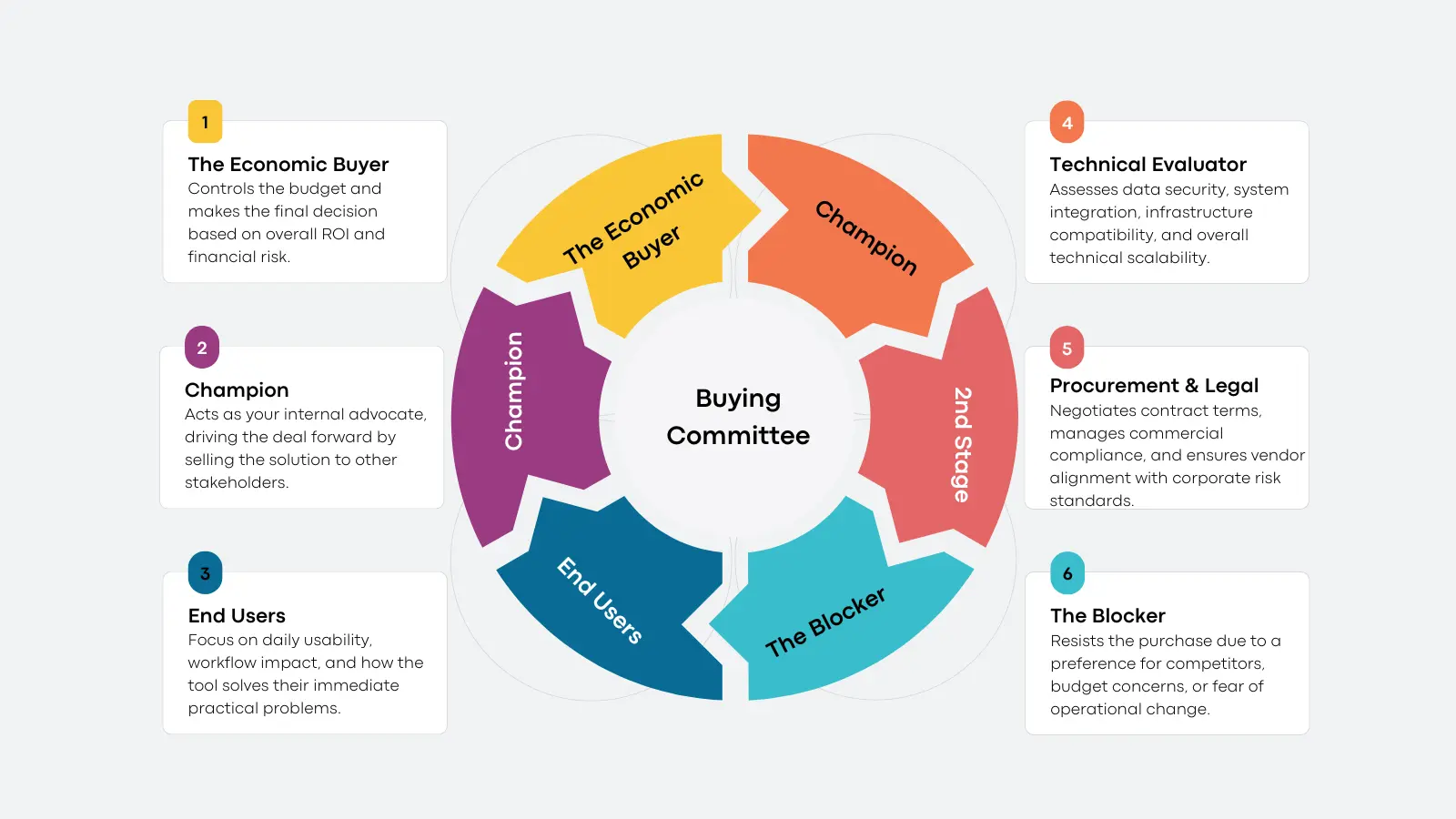
- The typical B2B buying group has 6 to 10 decision-makers. Your CRM is tracking one of them.
- Deals do not go dark because the buyer got busy. They go dark because a stakeholder you never met killed it.
- Multi-threading is not a nice-to-have on any deal worth keeping. It is the difference between a real forecast and a guess.
- Your CRM can track the entire buying committee. Most setups do not, because nobody configured them to.
- Map the committee first. Define the roles. Then make the CRM enforce stakeholder coverage on every real deal.
Every sales manager in Lebanon, Saudi Arabia, Jordan, and Syria has lived this story. The deal was hot. The discovery call went well. The demo was strong. The proposal went out on a Tuesday.
Then nothing. A week passes. Two weeks. Three. WhatsApp messages go unread. Emails get one-line replies, then nothing. A month in, you get the message: "We have decided to go with another solution", or "We are putting this on hold for now," or the most painful one, "Let us revisit this next quarter."
The team looks at you. You look at the CRM. The CRM has nothing. You tell your manager: "I do not know what happened."
That is the wrong answer. Something specific happened. You just could not see it, because your pipeline was watching the wrong number of people.
The Math of a Modern B2B Decision
Research from Gartner has been consistent on this for almost a decade: the typical buying group for a complex B2B solution involves six to ten decision-makers. Newer data from Forrester's 2024 State of Business Buying report has pushed that number even higher, with the average B2B purchase now involving roughly 13 stakeholders across multiple departments.
Six to ten. Sometimes thirteen. Your CRM is tracking one of them.
It gets worse. Gartner's research also shows that B2B buyers spend only about 17% of their total purchase time meeting with potential vendors. The other 83% happens inside their organization. Internal meetings. Procurement reviews. Finance debates. Slack threads. WhatsApp groups. Conversations between people you have never spoken to, about a decision you are heavily invested in.
Your rep was talking to one person. That person was one of seven. And the deal was being decided in a room your rep was not in.
Why Your CRM Cannot See Any of This
Open any deal in any CRM, anywhere in the world. By default, the deal structure looks like this: one primary contact, one email, one phone number, one calendar. Your rep enters Ahmed. They make calls to Ahmed. They log meetings with Ahmed. They send proposals to Ahmed. The CRM shows you a beautifully documented relationship with Ahmed.
Meanwhile, inside Ahmed's company:
- There is a CFO who hates new SaaS subscriptions on principle.
- There is a Head of Operations who already has a tool they like and would rather not switch.
- There is an IT lead worried about integration with three legacy systems nobody has documented.
- There is a procurement officer who needs three competing quotes by policy.
- There is an end-user manager whose team will actually use the tool, and whose buy-in nobody has asked for.
None of them appear in your CRM. None of them appear in your forecast. None of them are getting called, emailed, or sent a tailored piece of content. And any one of them can kill the deal without your rep ever knowing they exist.
When your rep says "I am talking to the decision-maker," ask one question back: who else has to say yes for this to happen?
Why MENA SMBs Get Hit Harder Than People Think
There is a common belief in this region that the committee problem is an enterprise problem, not an SMB problem. That belief costs deals every quarter.
Family-owned businesses in Lebanon, Saudi Arabia, Jordan, and Syria run on informal hierarchies. The org chart shows the owner at the top, a few department heads underneath, and maybe a dozen staff. It looks like a one-person decision.
It is not. The owner says yes, but the cousin running operations can veto. Procurement is the owner's brother-in-law. The longtime finance manager has been with the family for 20 years and is the one whose opinion actually moves the owner. The IT person might be an external consultant who shows up twice a month and whose recommendation carries more weight than anyone in the building.
The committee exists. It is just not on the org chart. And because it is informal, it is even harder to map than an enterprise buying group. You will not find it by asking for it. You have to earn the right to be told who is really in the room.
Why Deals "Go Dark", Specifically
When a deal goes silent, one of these things almost always happened, and your CRM had no way to see any of them coming:
Your champion lost an internal fight. They tried to sell your solution to the CFO, did not have the right numbers, and got shut down. They are not ignoring you. They are losing.
A new stakeholder got brought in late. Someone senior asked a question your champion could not answer. The deal stopped to wait for an opinion that never came back positive.
Procurement got involved without your knowledge. They quietly added two competitors. The conversation you were having is no longer the conversation that is being had.
Budget got reallocated. A CFO you have never met decided this quarter's money goes elsewhere. Your champion has no leverage to push back.
The status quo won. Nobody actively chose against you. They just never built enough internal consensus to choose for you. That is how most B2B deals die, quietly, without a decision ever being made.
The Multi-Thread Playbook
Multi-threading means deliberately building relationships with multiple stakeholders across the buying committee, not just your primary contact. It is the single most effective discipline a B2B sales team can adopt, and most teams in the region simply do not do it.
Here is how we implement it with clients:
Set a Minimum Stakeholder Count Per Deal
Any deal above a certain value (we usually start at three months of average deal size) cannot be considered "active" with only one contact. Minimum two, ideally three, mapped stakeholders before the deal qualifies for sales effort.
Build a Stakeholder Map for Every Real Deal
For each deal, document who is in the buying committee, what role they play, and where they stand. Not as a one-off exercise. As a permanent record that updates as you learn more.
Different Stakeholders, Different Conversations
The CFO wants payback period and risk. The end user wants ease and reliability. The IT lead wants integrations and security. The same pitch does not work for all three. Map the conversation to the role.
Arm Your Champion to Sell Internally
Your champion does most of the selling when you are not in the room. Give them what they need to win: a one-page business case, a short ROI summary, two reference stories, answers to the three objections they will face. Make their job easier.
Make Stakeholder Coverage a Stage Exit Criterion
A deal cannot move into the proposal stage until the committee is mapped and at least the economic buyer has been engaged. No mapping, no advancement. The CRM enforces this. Reps cannot skip it.
Who You Are Actually Looking For
A complete stakeholder map names the people in these roles, even when those roles are informal:
The Economic Buyer
Has budget authority. Signs the check. Often invisible in the early conversation. If you do not know this person's name and priorities by mid-cycle, you do not have a real deal.
The Champion
Wants this to happen. Sells your solution internally when you are not there. Your single most important relationship in the account. They need information, ammunition, and a clear path to a yes.
The End Users
The people who will actually use the thing day to day. Their adoption decides whether you renew, expand, or get churned out after 12 months. Their resistance can kill a deal late, when they tell their manager "we hate it."
The Technical Evaluator
IT, security, integrations. Asks questions that sound minor and are not. If your champion cannot answer their concerns, the deal stalls in an "evaluation" that has no end date.
Procurement and Legal
Show up late, with their own agenda. Need three quotes, certain contract terms, vendor onboarding paperwork. The faster you flush them out, the less damage they do to your timeline.
The Blocker
Often the most important person to identify, and usually the last one your rep notices. Someone whose status quo your solution disrupts, and who has the political weight to slow the decision until it dies. They almost never declare themselves.
How to Track a Buying Committee in Pipedrive
The CRM we use and recommend, Pipedrive, supports multi-stakeholder deals natively. Most teams just never set it up to use that capability.
Here is the configuration we deploy with our clients:
Link multiple People to every Deal. Not just one primary contact. Every named stakeholder on the committee gets attached to the Deal as a Participant. This is built into Pipedrive. It takes about 10 seconds per person.
Add two custom fields to every Person: Role (with options: Economic Buyer, Champion, End User, Technical Evaluator, Procurement, Blocker, Influencer) and Stance (with options: Champion, Supporter, Neutral, Skeptic, Blocker). Every named stakeholder gets tagged.
Make Participant count a required field on stage transitions. A Deal cannot leave the discovery stage with only one Participant. A Deal cannot enter the proposal stage without an identified Economic Buyer. The CRM blocks the move if the data is not there.
Build a stakeholder coverage report. Filter all open deals where Participants are fewer than three, or where no Economic Buyer is identified, or where no Champion is tagged. That report is your weekly pipeline risk review, in one view.
One conversation with the CFO is worth ten more conversations with the same champion. Both are useful. Only one of them moves the deal.
What Changes When You Run This
The teams we move from single-threaded to multi-threaded selling see four shifts within a quarter:
Deals stop going dark without warning. When your champion goes quiet, you have other paths in. You hear about the budget freeze from the CFO contact, not from a one-line apology three weeks later.
Internal opposition surfaces early. The blocker who would have killed the deal silently in week eight is now identified in week two. You either neutralize them or qualify the deal out. Both are better than waiting.
Forecast accuracy actually improves. Not because your reps got better at predicting. Because the pipeline can finally see whether a deal has real committee consensus or one enthusiastic champion talking to themselves.
Champion redundancy. If your champion leaves the company (and in this region, they do), the deal does not leave with them. You have other relationships that can carry it forward.
Map the room before you walk into it.
Single-contact selling is how deals quietly die in this region. The committee exists in every B2B deal you have, whether or not your CRM acknowledges it. The work is to find the committee, name the roles, and build the discipline that makes your pipeline reflect the actual decision happening inside the buyer's organization. The CRM is the enforcement layer. The discipline is the work.